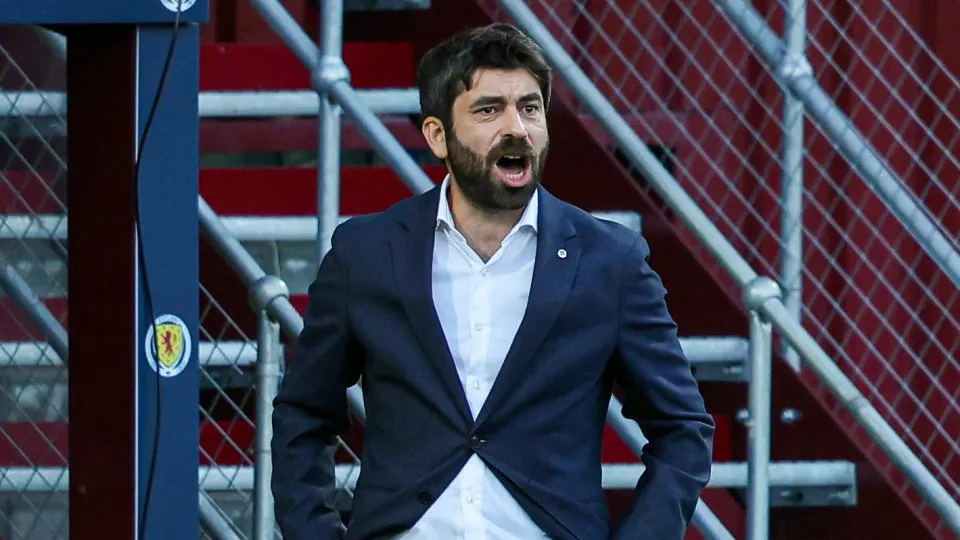
“ANDThis awareness is being raised. Those who make the rules of the I League are the clubs, but the FPF has the role of working with them and trying to make things better. I think there has been more sensitivity. We have several clubs looking at the young Portuguese player and who, perhaps, were not so aware last season. We must continue this work and commitment, because the footballers have proven their value”, explained the 40-year-old coach, in an interview with the Lusa agency.
In the first nine rounds of the 2026/27 edition of the I League, the 18 teams have already used 115 Portuguese and 331 foreigners, for a total of 446 athletes.
Including this data on those who were born after 2004 and are eligible to represent Portugal in the final phase of the under-21 European Championship in 2027, the primary clubs have so far launched 41 players in the championship, with Moreirense standing out, with five, followed by Sporting, Gil Vicente and Estoril Praia, each with four, while Marítimo is the only one with ‘zeros’.
“The increase in loans from last season to this one shows that clubs are more sensitive to this issue, because, being able to loan more players, there are more opportunities to do this type of business. It was a rule that we changed. It doesn’t mean that everything is fine now, but there is an improvement”, assessed Luís Freire, convinced that an under-20 or under-21 international “has the quality to compete at a high level” inside or outside the country.
In 2025/26, a season that coincided with the arrival of Rui Jorge’s successor as technical command of the ‘hopes’ group, the 34 rounds of the I League involved 389 foreigners and 190 Portuguese, of which 62 were under-21s.
“There is enormous merit for the clubs in developing talent. The teams are good because the clubs work well and invest a lot in training. I’m talking about the four, five or six biggest ones. It doesn’t mean that the other clubs don’t invest, but they have had a big impact on the teams”, he observed.
Viewing the I League as a “natural space for young Portuguese players”. Luís Freire recalls the examples of those who “didn’t have as many opportunities in the main teams”, but “proved their value in more competitive championships”, and then “returned stronger to their original clubs or continued to develop in other teams and yielded financial income”.
“We need to believe in young people and give them that space. They are giving good responses. The greater the range of choices in the lower teams and the investment, the more easily the players will reach the under-21s and will be able to do so in numbers. I think that, in general, Portuguese football is aware. We have athletes who were under-17 world champions a year ago and we have to pay attention to their journey and encourage their evolution. Communication with the clubs has been quite positive”, he said.
In addition to promoting this awareness, Luís Freire, who is having his first experience as a national coach, intends to “form a strong team and try his best to bring joy to the Portuguese” in the under-21 European Championship.
“The level of being European champions is always very high. Our athletes are almost all from big teams and the idea of the game and the training methods have to be that of a big team. We spend a lot of time reflecting and trying to improve the process so that we have everything in tune and get them performing as quickly as possible”, he explained, about the challenge of “building a group in a short time, passing on ideas and competing to win on behalf of the country”.
Another mission is to “foster the love of playing for Portugal”, a scenario that led, among others, Mateus Mané, Fábio Baldé or Noah Saviolo, all with dual nationality, to debut in this cycle for the under-21s – the Turkish Trabzonspor winger had not even competed for the Portuguese youth teams.
“At the time, it was an unexpected step (in my career), especially because I hadn’t planned it, but when we received a call to represent Portugal with this generation of players, these conditions and the desire that the president and management showed in doing everything possible for us to play to win, it is always very motivating to embrace this project. After having covered all the levels of Portuguese football and reaching the European competitions, this opportunity arose and it is with great pride and honor that I accepted the challenge of taking these young people to the European Championship”, he highlighted.
With more than a decade guiding clubs, Luís Freire said he had a “close and trusting relationship” with Jorge Jesus, but ruled out revealing the ideas exchanged with the ‘AA’ selector about the Portuguese internationals.
