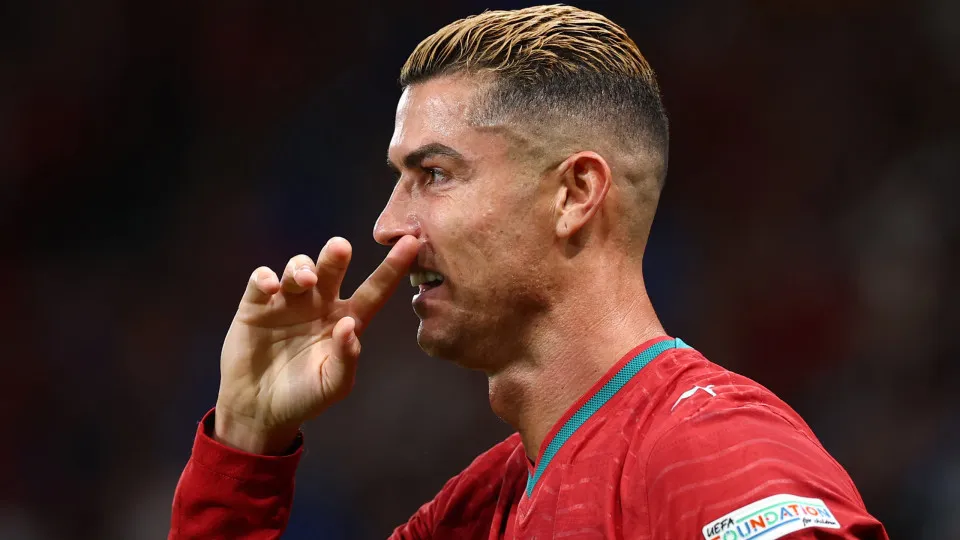
Wristiano Ronaldo said goodbye to the Portuguese football team after 23 years in which he won a European Championship, two Nations Leagues and defended the national colors in 12 final stages of major competitions, with different fortunes.
In the career of the now former Portugal captain, July 10, 2016 will always remain, the day he lifted the European champion’s cup in the Stade de France, on the outskirts of Paris, in the greatest feat ever in the history of national football.
Ronaldo was also in the final of Euro2004, his first tournament, at just 19 years old, in the semi-finals of the 2006 World Cup and also in the semi-finals of Euro2012.
Two Nations Leagues followed, in 2019 and 2025, two more titles in the golden ‘era’ of the ‘quinas’ team, with Ronaldo always as its greatest protagonist, a journey that leaves the Madeiran with an eternal place among the ‘gods’ of world football.
On an individual level, the forward, who decided to leave Portugal at the age of 41, ended his international career full of records and marks that seem to be unattainable in the near future, both in World Cups and European Championships.
He is the only player in the history of football to score a goal or more in six World Championships, he is the all-time top scorer in the qualifying stages, with 41, and he surpassed Eusébio’s record (nine), which had stood since 1966, as Portugal’s top scorer in a final stage of the competition, reaching 11.
Cristiano Ronaldo’s mark in Europeans is even greater and the Madeiran says goodbye to football for teams with the records for the most goals (14), the most games (30) and the most appearances (six) in the final stages.
On the other side of the scale, the 2014 World Cup, in Brazil, is recorded in his career as the worst participation ever in finals, with Portugal remaining in the group stage, in a tournament in which the striker played injured, while Euro2024, in Germany, was the only one of the 12 finals in which the striker was ‘blank’.
At Euro2004, which took place on national soil, Ronaldo contributed with two goals and learned at a young age what it was like to be in the final of a major competition, but also what it was like to lose a match of such importance, with Greece beating Portugal (1-0), at the Estádio da Luz, in Lisbon.
In the middle of the Scolari ‘era’, two years later, the Madeiran player competed in his first World Cup, in Germany, and only stopped in the semi-finals, in a defeat against France (1-0), in a campaign in which he scored just once.
At Euro2008, organized by Austria and Switzerland, Ronaldo was captain in the finals for the first time, but the national team fell in the quarter-finals to Germany (3-2). The striker scored just one goal again, in farewell to Scolari.
Carlos Queiroz came in, but the new coach only lasted one final phase, at the 2010 World Cup, in South Africa, and Ronaldo only celebrated once again. Portugal ended up defeated by Spain (1-0) in the round of 16.
Queiroz left, Paulo Bento entered and ‘CR7’ once again dreamed of his first title with the national team in 2012, at the European Championship in Poland and Ukraine, scoring three goals in a journey that stopped again against Spain, in the semi-finals, but only on penalties (0-0, 4-2 on penalties).
This campaign raised hopes for the World Cup in Brazil, but Portugal didn’t even make it to the knockout stage. Despite being visibly limited physically, Ronaldo still scored once.
With his international legacy at risk, as a title with Portugal took a long time to appear in his career, everything changed with the arrival of Fernando Santos as coach and with Euro2016.
During the campaign in France, Ronaldo scored three goals, equaling his best record in finals, and the national team celebrated the first and only major title in its history to date, after beating the host team, 1-0, after extra time.
The Madeiran scored 146 goals for Portugal, a record number at all levels, but none was as important as Éder’s accurate shot that day at the Stade de France.
For the first time, Portugal went to a World Cup with the status of European champion, in this case in Russia, in 2018, but it all ended abruptly in the round of 16 with Uruguay (2-1).
Ronaldo reached four goals in a major competition for the first time, but this feat was worth little.
‘CR7’ did even better at Euro2020, with five goals, but again Portugal fell early, and again in the round of 16, this time against Belgium (1-0), in Seville.
In what was seen as his last major competition, the forward scored just once in the 2022 World Cup, held during the winter in Qatar, although Portugal reached the quarter-finals, losing to Morocco (1-0).
After eight years and with two titles, Fernando Santos left his role as national coach and, when Roberto Martínez, his successor, was expected to start a new cycle in Portuguese football, the Spaniard ended up convincing Ronaldo to compete in two more final stages.
Euro2024, which ended in the ‘quarters’ against France (0-0, 5-3 on penalties), was a ‘nightmare’ for the striker, who was goalless on German soil, but World Cup2026 went much better.
In the United States, Mexico and Canada, Ronaldo celebrated three times and broke several records, but Portugal came up against Spain again and in the round of 16 (1-0).
